

We talk a lot on this blog about current events, disasters in progress or recent emergencies. While world events serve to remind us of the importance of proper preparation, by the time catastrophe strikes, it’s too late to prepare. So, assuming you’re not under six feet of snow or facing an oncoming tidal wave at this precise moment, what can you do today to begin prepping for an emergency?
In answer to that question, here are some key initial steps. Or, as we like to call it…
Preparing to prepare.
 Depending on where we live and time of year, we all have specific natural disasters that could potentially affect us. And while I’d need to prep a little differently for a flood than you might for an earthquake, there is a common set of first priorities. According to experts, those first priorities boil down to 1) having a kit, 2) making a plan, and 3) informing yourself.
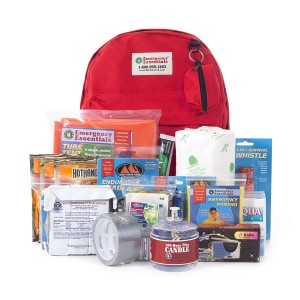
Have a kit. No matter whether you’re cut off by a mudslide or a blizzard has taken out the power, you’re going to need to eat, drink, and stay warm. A basic stash of supplies for the whole family will get you through those crucial first 72 hours. Office organizations like FEMA, the Red Cross, Ready.gov, and even the CDC offer helpful checklists of what to include in your emergency kit, but all of them include these basics:
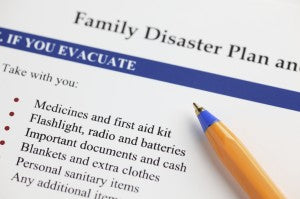
Depending on where we live and time of year, we all have specific natural disasters that could potentially affect us. And while I’d need to prep a little differently for a flood than you might for an earthquake, there is a common set of first priorities. According to experts, those first priorities boil down to 1) having a kit, 2) making a plan, and 3) informing yourself.
Have a kit. No matter whether you’re cut off by a mudslide or a blizzard has taken out the power, you’re going to need to eat, drink, and stay warm. A basic stash of supplies for the whole family will get you through those crucial first 72 hours. Office organizations like FEMA, the Red Cross, Ready.gov, and even the CDC offer helpful checklists of what to include in your emergency kit, but all of them include these basics:
- A three-day supply of water, figuring one gallon of water per person per day
- Three days’ worth of food for the whole family
- First aid supplies
- Flashlights and batteries
- Knife, can opener, wrench, or other multifunction tool
- Extra clothing and shoes
- Toiletries
- Medications
- Infant or pet needs
- Blankets
- Cash
- Important documents
- The safest place inside your home to hunker down, as in the case of an earthquake or tornado
- Best escape routes out of the house (have at least two!)
- Two designated meeting points: somewhere close, but clear of your home; and an out-of-town location for larger-scale evacs
- A communication strategy—who will call whom, by what point does everyone need to check in, and how will we reach each other if cell towers are down?
- Know which natural disasters are likely in your area, and learn disaster-specific preparation.
- Learn about your community’s notification systems and protocols for emergencies, including schools and hospitals.
- Sign up for local or national text alerts.
- Certify in CPR.
- Learn how to use a fire extinguisher, shut off utilities, and prepare a home for severe weather.
- Organize a neighborhood emergency response team.
- Beef up your survival skills—building a fire, constructing a shelter, cooking outdoors, etc.
—
Emergency Essentials
Comments
Here is my question:
I am mystified and confused on figuring out where our family
would meet, locally + out of town.How do you do that ?
How do you figure that out?
Do you meet at a hotel ? Or in a parking lot a distance from your house ?
Chances are the whole city would be in ruin. (Earthquakes are our concern).
Or if having to leave the city (if possible) would mean the roads + freeways would be jammed up.
We have animals that would not be left behind. They are not allowed in shelters so would that mean we would all live in our SUV ? I have read that they would need to be “placed” some where. How does that work ?
No place would be specically + immediately ready to accept any animal.
If you have any suggestions or answers to any of the questions above I would be ever so grateful.
I did inquire re: the above at the local Firehouse but they had no answers and seemed a bit confused also.
I have done well in preparing to prepare. I still need to fine tune some specific areas, and I’m working on that.
Sometimes I feel like I am building Noah’s Ark because my friends +
family make fun of me.
I like the fact that you are committed. I’m going to follow your example and become better prepared.
My neighbor was thinking about turning off the power for one weekend, (in secret for safety) and see how your plan and equipment does and doesn’t work. Our family is also going to try this. It may be really important for our special daughter to have this experience too.
Being prepared isn’t silly, it’s choosing to be grown-up and responsible.