


 Kathmandu has now taken an unenviable place in modern history, a place now known for grief and sorrow. Such distinction is shared by San Francisco-USA, Messina-Italy, Port au Prince-Haiti, Kanto-Japan, Ancash Region-Peru, Haiyuan, Tangshan and Sichuan Province-China, Turkmenistan, Pakistan, the eastern Coasts of the Indian Ocean, and many other diverse places. All are modern scenes of great death and destruction brought about by earthquake. The images from all are iconic, and are continual reminders that serenity is a delicate state, that where lies peace and tranquility may become calamity and devastation in mere seconds. Nepal becomes another example what we can expect when the unexpected happens. More importantly, we are reminded of how important it is to prepare for the real and lasting effects that follow these disasters.
[caption id="attachment_18052" align="alignright" width="300"]
 Associated Press[/caption]
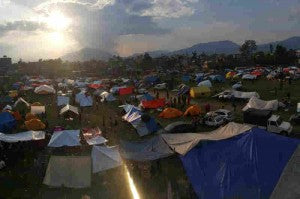
A few days after the devastating Nepal earthquake happened, I wrote about how the postcard-beauty of Kathmandu had become a pile of rubble surrounded by a tent city. Of all the images from this devastation, it was the vast hillsides of tarps and blankets that most poignantly struck me. From the immediate outset, emergency shelter was a major concern for those effected by the earthquake.
After the earthquake, half a million tents were needed to provide shelter for the masses left without a roof over their head. And, to make matters worse, this may only be the preface to the Nepalese crisis; monsoon season is mere weeks away. Soon may follow downpours of rain, followed by extreme heat. Definitely not a time to be left without shelter.
As happy and comfortable people, we tend to think about emergency preparedness as a short-term solution. We live and breathe our “72-hour kit plan” but don’t expect to be inconvenienced any longer than that. Don’t get me wrong, 72-hour kits and emergency kits are vital. And, for many situations, a 72-hour kit will be all you need. However, there are instances – such as the Nepal earthquakes – where a 72 hour kit will be your bread and butter for the first three days, but after that, you’re going to need something a little more…permanent.
That’s where emergency shelter comes into play.
It’s been almost three weeks since the 7.8 earthquake in Nepal struck. Since then, many countries have donated shelters to the shelterless people of Kathmandu and other regions; Britain has donated more than 65,000 shelters, with more on the way. So why is shelter so important? Let’s use Kathmandu to explain why.
- The Elements
 BBC[/caption]
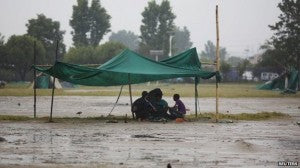
This is probably the most obvious reason. Rain can really put a damper on things if you’re stuck out in it. With monsoon season on its way, there has already fallen quite a bit of rain on the affected areas in Nepal – and therefore the people. And then there’s the wind. Unless their tarps and blankets are anchored by rocks, the wind will make short the benefits of their makeshift shelters.
Staying warm and dry is essential to physical health and general sanity (imagine all those afternoons watching your kids on a windy, rainy soccer field…now imagine you can’t go home…sick, tired and crazy!). Then, there is the sun factor, and the burn that cannot be blocked (remember the soccer field, again). In Nepal, shelter from rain, wind, and sun are only the beginning of why shelter is essential if they are to prevent illness, sleep at night, and survive. Reason enough to have a shelter plan?
- Hot and Cold
- Sanitation
- Insects


—
Emergency Essentials
Comments
Class C RV for us. It’s self contained with water, refrigeration, stove, solar power, sanitation, generator if needed, and ample storage for food, clothing, and other basic needs. Plus it’s fun to take our survival shelter camping and try everything out!